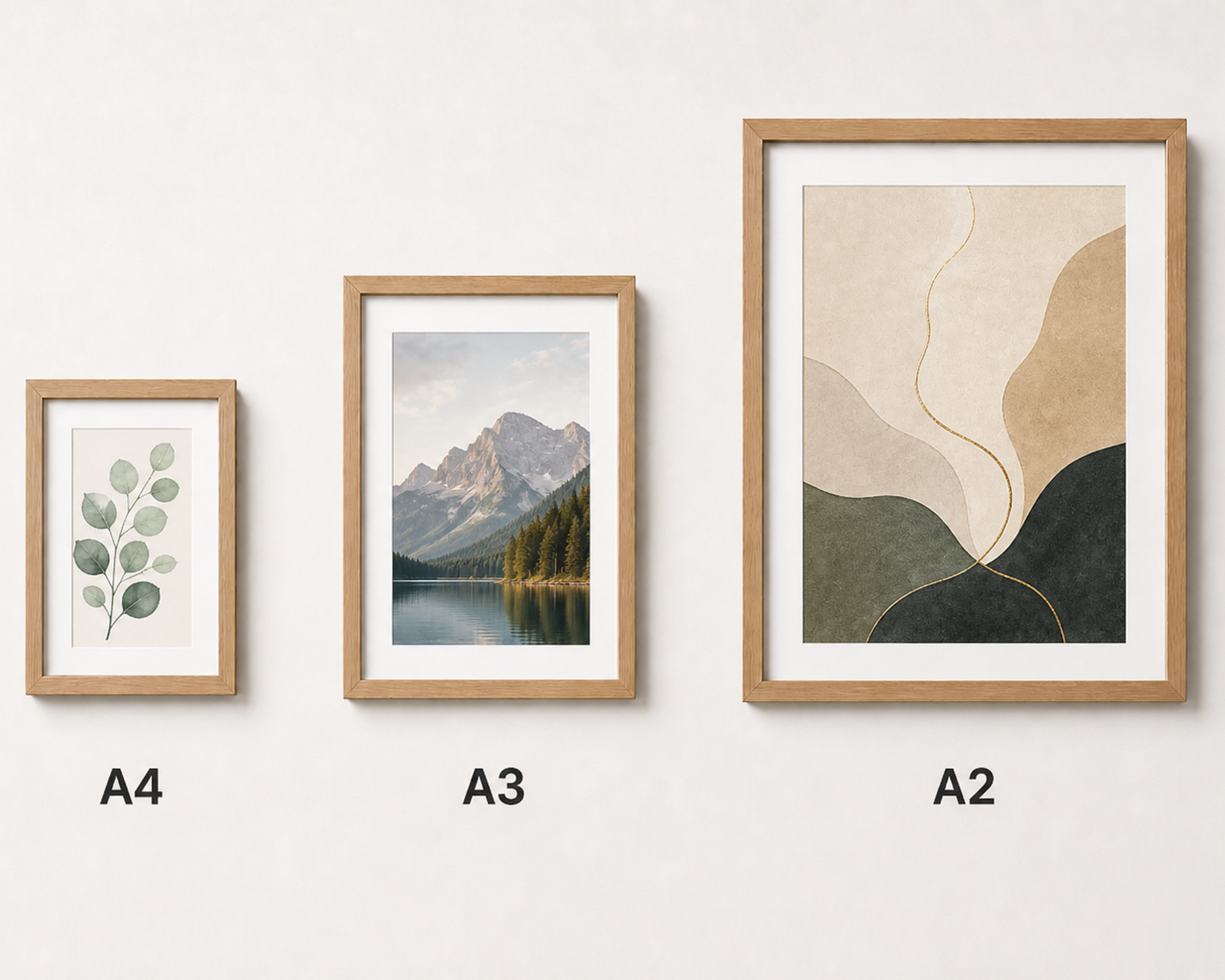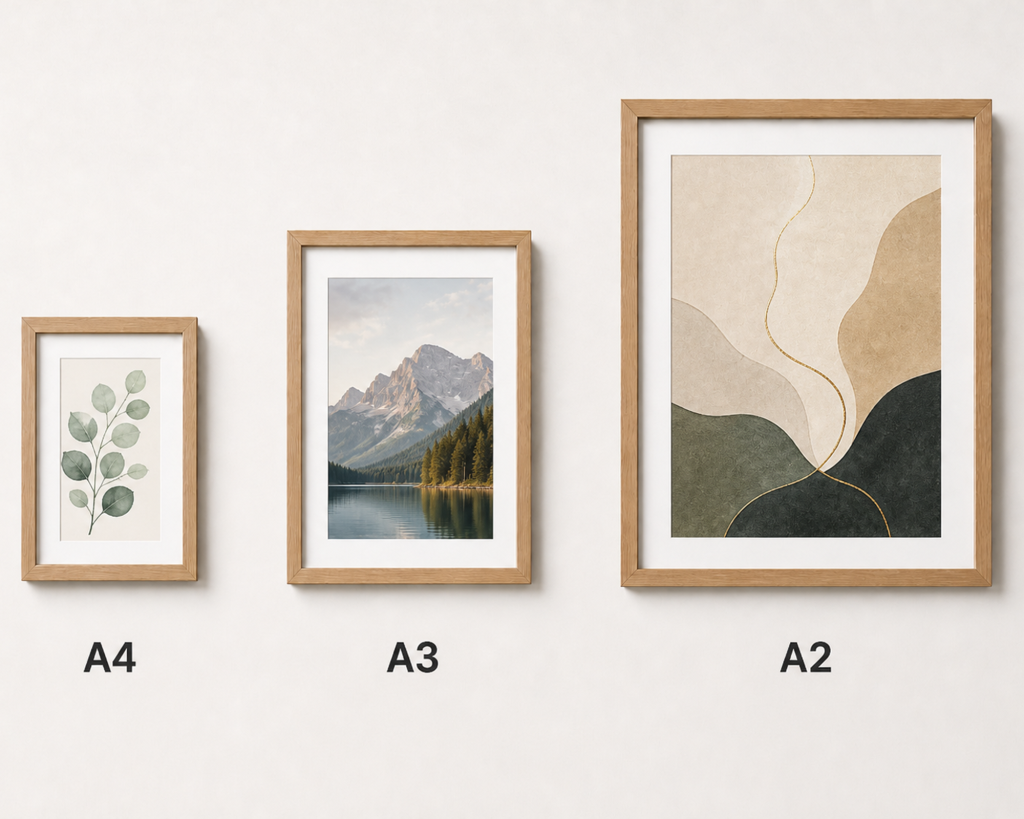
Frame Sizes Explained: A4 vs A3 vs A2
Frame Sizes Explained: A4 vs A3 vs A2
Understanding picture frame sizes
Choosing the right picture frame size can feel confusing, especially when you see options such as A4, A3 and A2. These sizes are commonly used for prints, posters, certificates, artwork and photography, but it is not always obvious which one you need.
The most important thing to remember is that the frame size usually refers to the size of the item going inside the frame, not the outside edge of the frame. So, an A4 frame is designed to hold an A4 print, certificate or document.
If you are framing something with a mount, the frame itself will usually be larger than the print, because the mount creates a border around the image.
Lets dive in, Frame Sizes Explained: A4 vs A3 vs A2

A4, A3 and A2 frame sizes at a glance
| Size | Measurements | Common uses |
|---|---|---|
| A4 | 210 × 297 mm | Certificates, documents, small prints, photos |
| A3 | 297 × 420 mm | Medium prints, posters, artwork, photography |
| A2 | 420 × 594 mm | Larger posters, statement prints, artwork |
Each size doubles as you move up the A-series. For example, A3 is twice the size of A4, and A2 is twice the size of A3.
What size is an A4 frame?
An A4 frame is designed for an item measuring 210 × 297 mm. This is the same size as a standard sheet of printer paper.
A4 frames are popular for:
- Certificates
- Qualifications
- Documents
- Small art prints
- Children’s artwork
- Letters or keepsakes
- Portrait and landscape photos
A4 is a good choice when you want something neat, simple and easy to display. It works well on desks, shelves, gallery walls, home offices, hallways and smaller rooms.
Should you add a mount to an A4 print?
Adding a mount to an A4 print can make it look more professional, but it means the outer frame size will be larger than A4.
For example, an A4 print with a mount might sit inside an A3 frame, depending on the border size you want. This gives the image more breathing space and creates a cleaner gallery-style finish.
What size is an A3 frame?
An A3 frame is designed for an item measuring 297 × 420 mm. It is twice the size of A4, making it a popular choice for medium-sized prints and posters.
A3 frames are commonly used for:
- Art prints
- Photography
- Posters
- Illustrations
- Larger certificates
- Menus or signage
- Statement pieces for smaller walls
A3 is a versatile size because it is large enough to stand out, but not so big that it dominates a room. It works well in living rooms, bedrooms, kitchens, offices and hallways.
A3 with or without a mount
If your print is already A3 and you want it to fill the frame, choose an A3 frame without a mount.
If you want a more premium look, you could place an A3 print inside a larger frame with a mount. This is often used for photography, limited edition prints and artwork where presentation matters.
What size is an A2 frame?
An A2 frame is designed for an item measuring 420 × 594 mm. It is twice the size of A3 and four times the size of A4.
A2 frames are ideal for:
- Large posters
- Statement art prints
- Photography
- Exhibition prints
- Graphic design prints
- Wall art
- Feature pieces above furniture
A2 is a great option when you want your framed piece to become a focal point. It works especially well above a sofa, sideboard, bed, fireplace or desk.
Because A2 is noticeably larger than A3, it is worth thinking carefully about where it will hang before ordering. Measure the wall space and make sure there is enough room around the frame so it does not feel cramped.
A4 vs A3 vs A2: which frame size do you need?
The right size depends on what you are framing and where it will go.
Choose A4 if you are framing a certificate, document, small print or something for a compact space.
Choose A3 if you want a medium-sized frame that works well as part of a gallery wall or as a standalone print.
Choose A2 if you want a larger statement piece that will stand out on the wall.
A simple way to compare them is:
- A4: small and neat
- A3: medium and versatile
- A2: large and eye-catching
Portrait or landscape?
A4, A3 and A2 frames can usually be used in either portrait or landscape orientation, depending on the item you are framing.
Portrait frames are taller than they are wide. These work well for certificates, vertical artwork, portraits and documents.
Landscape frames are wider than they are tall. These are ideal for panoramic photos, horizontal posters, landscape artwork and wider designs.
Before choosing your frame, check the orientation of your print. An A3 frame, for example, can hold an A3 print whether the print is portrait or landscape, as long as the measurements are correct.
What if your print is not exactly A4, A3 or A2?
Not every print, poster or photograph follows a standard paper size. Some artwork is printed in inches, some photographs use photographic sizes, and some older prints or posters may be slightly irregular.
If your item is not exactly A4, A3 or A2, you have two main options.
You can choose a larger standard frame and use a mount to fit the item neatly inside it, or you can order a made-to-measure picture frame for an exact fit.
Made-to-measure framing is often the best choice for unusual sizes, valuable artwork, signed prints, sentimental items or anything where you want a cleaner finish.
Frame size vs image size vs mount size
This is where many people get confused.
The image size is the size of the print, photo or artwork.
The mount opening is the cut-out window that shows the image.
The frame size is usually the size of the item or mount that fits inside the frame.
For example, if you have an A4 print and want to add a mount, the mount will sit around the A4 print, so the frame will need to be larger than A4.
This is why it is important to decide whether you want a mount before choosing your frame size.
Should you use a mount?
A mount is the card border that sits between the image and the frame. It can make a framed piece look more finished and professional.
A mount can help:
- Add space around the image
- Draw attention to the artwork
- Create a more premium finish
- Prevent the image from looking cramped
- Help a smaller print fit a larger frame
Mounts are especially popular for certificates, photography, art prints, wedding photos, family portraits and limited edition prints.
For modern posters, graphic prints and bold wall art, some people prefer the image to fill the frame without a mount. Both options can look good; it depends on the style you want.

Common frame size examples
Here are a few typical combinations:
| Item being framed | Possible frame choice | Result |
|---|---|---|
| A4 certificate | A4 frame | Simple, close fit |
| A4 print | 14×11″ frame with mount | More premium gallery look |
| A3 poster | A3 frame | Clean poster-style finish |
| A3 artwork | 20×16″ frame with mount | Larger, more decorative display |
| A2 poster | A2 frame | Bold statement piece |
These are not fixed rules, but they are useful starting points.
How to measure before ordering a frame
Before ordering a frame, measure the item carefully using millimetres if possible.
Measure the width first, then the height. For example, A4 is 210 mm wide by 297 mm high in portrait orientation.
If the item is slightly smaller or larger than expected, do not force it into the nearest standard size. Even a few millimetres can affect how well the frame fits.
If you are unsure, measure the visible image area as well as the full paper size. This is especially useful if the print already has a white border.
Choosing the right frame colour
Once you know the size, the next step is choosing the frame style.
Popular choices include:
- Black frames for a clean, modern look
- White frames for a fresh, simple finish
- Oak or wood-effect frames for warmth and natural interiors
- Gold frames for a more decorative or traditional style
- Silver frames for certificates, awards and contemporary spaces
For certificates and documents, black, white and silver are popular. For artwork and photography, the best colour often depends on the tones in the image and the décor of the room.
Where to use A4, A3 and A2 frames at home
A4 frames work well in smaller spaces, home offices, shelves and gallery walls.
A3 frames are a good all-round option for bedrooms, kitchens, hallways and living rooms.
A2 frames are best for larger walls or places where you want the frame to stand out, such as above a sofa, bed, desk or sideboard.
If you are creating a gallery wall, mixing A4 and A3 frames can create a balanced look. A2 frames usually work better as a central feature or anchor piece.

Frame sizes explained: final advice
When choosing between A4, A3 and A2 frames, start with the size of the item you want to frame. Then decide whether you want the item to fill the frame or sit inside a mount.
As a guide:
- Use A4 frames for certificates, documents and smaller prints
- Use A3 frames for medium prints, posters and artwork
- Use A2 frames for larger posters, statement prints and wall art
- Use a larger frame with a mount if you want a more professional finish
- Use a made-to-measure frame if your item is not a standard size
The right frame size should protect your item, suit your space and make the finished piece look intentional.
Need help choosing the right frame size?
If you are unsure whether you need an A4, A3 or A2 frame, Boldon Framing can help you choose the best option for your print, poster, certificate or artwork.
Whether you need a standard frame, a frame with a mount, or a made-to-measure picture frame, we can help you create a finished piece that looks right in your home or workplace.