How to Attach D Rings and Picture Cord to a Picture Frame
How to Attach D Rings and Picture Cord to a Picture Frame
Attaching D rings and picture cord to a frame
D rings and picture cord are one of the most common ways to hang picture frames. They are simple, reliable and suitable for many standard wooden frames, photo frames, prints, posters and artwork.
If your frame does not already have hanging fittings attached, you can often add them yourself using the right hardware and a careful approach. The key is to position the D rings correctly, use fixings that suit the frame, and tie the cord securely.
This guide explains how to attach D rings and picture cord to a frame, including where to place them, how much slack to leave and common mistakes to avoid.
What are D rings?
D rings are small metal hanging fittings shaped like the letter D. They are usually attached to the back of a wooden picture frame with screws.
Once fitted, picture cord or picture wire can be tied between the two D rings. The frame can then be hung from a picture hook, screw or wall fixing.
D rings are commonly used for:
- Wooden picture frames
- Framed photographs
- Art prints
- Posters
- Certificates
- Canvas-style frames
- Medium-sized wall frames
They are popular because they keep the hanging cord hidden behind the frame and allow the picture to sit neatly on the wall.
What picture cord should you use?
Picture cord is available in different thicknesses and strengths. The best choice depends on the size and weight of the frame.
For small or lightweight frames, standard picture cord is usually enough. For larger or heavier frames, use stronger picture cord or picture wire rated for the weight of the frame.
Before choosing cord, think about:
- The weight of the finished frame
- The size of the frame
- The type of wall fixing you will use
- Whether the frame has glass
- Whether the frame will hang in a busy area
If the frame is heavy, valuable or unusually large, it is worth getting professional advice before hanging it.
Tools and materials you will need
To attach D rings and picture cord to a frame, you will usually need:
- Two D rings
- Two suitable screws
- Picture cord or picture wire
- Tape measure or ruler
- Pencil
- Small screwdriver
- Bradawl or small drill bit
- Scissors
- Optional: masking tape
- Optional: protective cloth or towel
Use screws that are short enough not to come through the front of the frame, but long enough to hold securely in the wood.
Check the frame before you start
Before fitting D rings, place the frame face down on a clean, soft surface. A towel or blanket can help protect the glass and frame finish.
Check the back of the frame carefully. Make sure the frame is made from a material that can safely take screws. Most wooden frames are suitable, but very thin, plastic or metal frames may need different fittings.
Also check that the frame is strong enough to support the weight of the glass, mount and artwork once it is hanging.
Do not screw into the backing board only. D rings should be attached to the frame itself, not just the back board.
Where to position D rings on a frame
The position of the D rings is important. If they are too high, the frame may lean forward. If they are too low, the cord may show above the frame when it is hung.
As a general guide, position the D rings around one third of the way down from the top of the frame.
For example, if the frame is 60 cm tall, measure roughly 20 cm down from the top on each side.
Make sure both D rings are fitted at the same height. If one is higher than the other, the frame may hang unevenly.
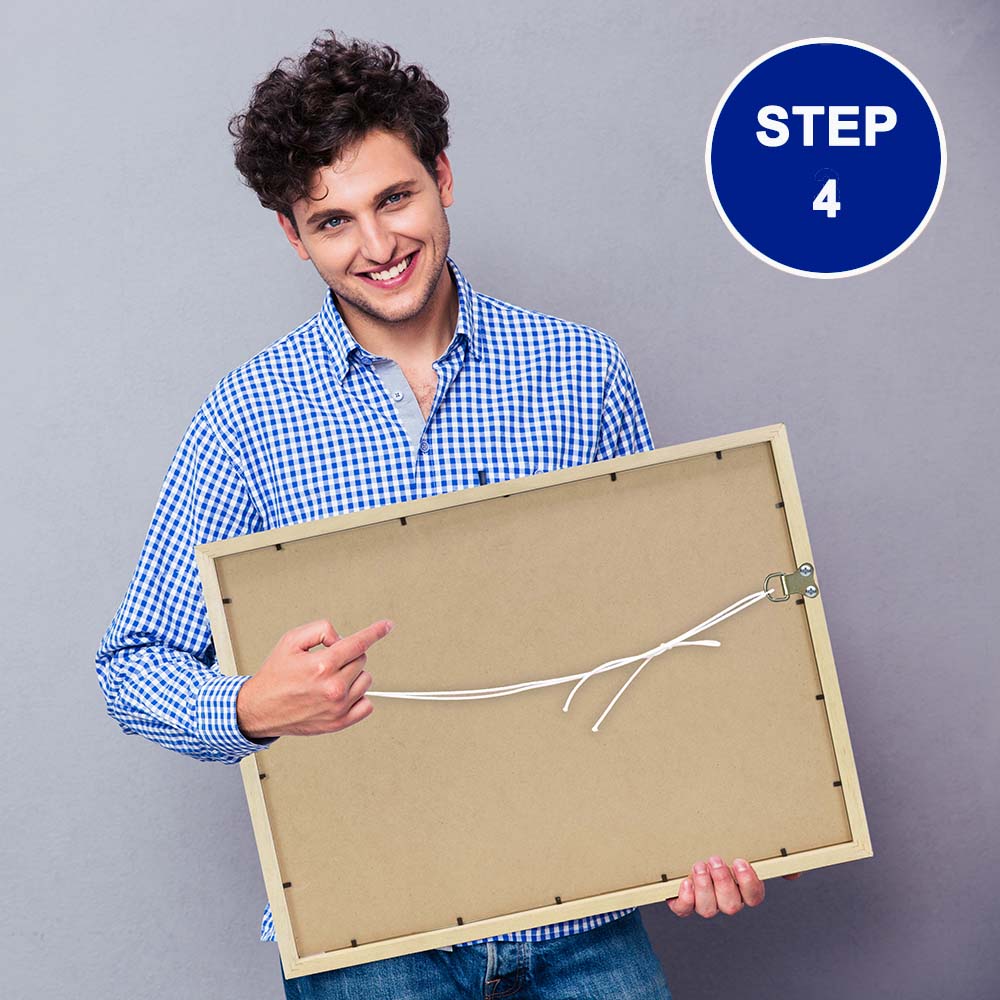
Step 1: Measure and mark the D ring position
Lay the frame face down with the top of the frame pointing away from you.
Measure down from the top edge on one side of the frame. Mark the position lightly with a pencil.
Repeat the same measurement on the other side.
Double-check that both marks are level and the same distance from the top. Taking a little extra time here can save problems later.
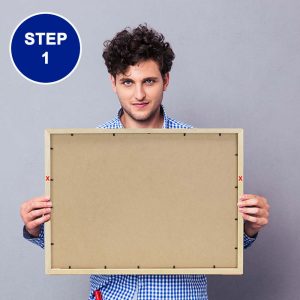
Step 2: Position the D rings
Place each D ring over the pencil mark, making sure the ring points towards the inside of the frame.
The screw hole should sit on the side rail of the wooden frame, not on the backing board.
Before screwing them in, check that the D rings are facing each other. This makes it easier to tie the cord securely between them.
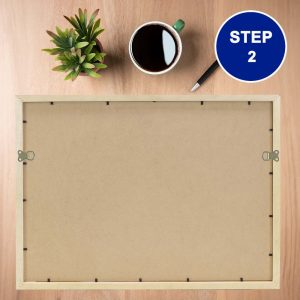
Step 3: Make a small pilot hole
A small pilot hole helps prevent the wood from splitting and makes the screw easier to insert.
You can make a pilot hole using a bradawl, small drill bit or sharp point. The hole should be smaller than the screw, so the screw still grips firmly.
Be careful not to drill too deeply. The screw should not come through the front or side of the frame.
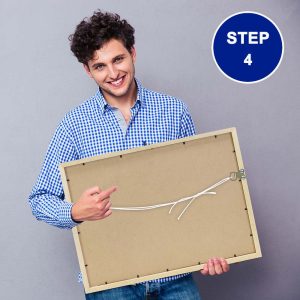
Step 4: Screw the D rings into the frame
Place the D ring back over the pilot hole and insert the screw.
Tighten the screw carefully until the D ring is secure. Do not overtighten, as this can damage the frame or strip the screw hole.
Repeat on the other side.
Once both D rings are fitted, gently pull on them to check they are secure. They should not wobble or pull away from the frame.
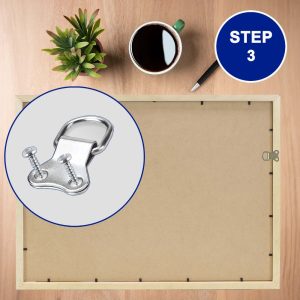
Step 5: Attach the picture cord
Cut a length of picture cord longer than the distance between the two D rings. It is better to start with too much cord than too little.
Thread one end of the cord through the first D ring. Tie it securely using a strong knot, then wrap the loose end around the main cord several times before trimming any excess.
Repeat on the other side, but do not pull the cord too tight. The cord needs some slack so it can sit over the picture hook.
How much slack should picture cord have?
The picture cord should form a gentle triangle when pulled upwards from the centre.
As a guide, when you pull the cord up towards the top of the frame, it should stop below the top edge of the frame. This helps keep the cord hidden when the frame is hanging.
If the cord rises above the top of the frame, it may be visible on the wall. If the cord is too tight, it can put extra strain on the D rings and make the frame harder to hang.
A good rule is to leave enough slack for easy hanging, but not so much that the cord shows above the frame.
Step 6: Test the cord before hanging
Before putting the frame on the wall, test the cord by gently lifting the frame from the centre of the cord.
Check that:
- The knots hold firmly
- The cord does not slip
- The D rings stay secure
- The frame hangs level
- The cord does not show above the frame
If anything feels loose, retie the cord or check the screws before hanging the frame.
Best knots for picture cord
There are several ways to tie picture cord, but the most important thing is that the knot is secure and does not slip.
A common method is to:
- Thread the cord through the D ring
- Tie a firm knot around the ring
- Wrap the loose end around the main cord several times
- Tie off the end again
- Trim any excess cord
For heavier frames, use stronger cord or picture wire and make sure the knots or twists are suitable for the weight.
Picture cord vs picture wire
Picture cord is easy to tie and works well for many standard frames. Picture wire is stronger and often used for heavier frames.
Picture cord is often suitable for:
- Small and medium frames
- Lightweight photos
- Prints and posters
- Certificates
- Frames with acrylic glazing
Picture wire may be better for:
- Larger frames
- Heavier frames
- Frames with glass
- Artwork in wider mouldings
- Commercial or gallery displays
If you are unsure, choose a hanging method that is rated above the weight of your frame.
Choosing the right wall fixing
Attaching D rings and picture cord is only part of the job. The wall fixing also needs to be suitable.
A small lightweight frame may only need a standard picture hook. A larger or heavier frame may need screws, wall plugs or specialist fixings depending on the wall type.
Common wall types include:
- Plasterboard
- Brick
- Block
- Stud walls
- Stone
- Concrete
Always choose a wall fixing that suits both the wall and the weight of the frame. A secure frame fitting will not help if the wall hook is not strong enough.
How to hang the frame level
Once the D rings and cord are fitted, hold the frame against the wall and decide where you want it to hang.
Mark the wall lightly where the hook or fixing will go. Remember that the hook position will usually be higher than the final top edge of the frame, because the cord sits below the top of the frame when hanging.
After hanging the frame, use a spirit level or step back and check it by eye. Adjust the frame gently until it sits straight.
Common mistakes when attaching D rings and picture cord
One common mistake is attaching D rings to the backing board instead of the frame. The backing board is not usually strong enough to carry the weight of the frame.
Another mistake is placing the D rings too close to the top. This can make the frame lean forward or cause the cord to show above the frame.
Other common mistakes include:
- Using screws that are too long
- Using screws that are too short
- Fitting the D rings at different heights
- Pulling the cord too tight
- Leaving the cord too loose
- Using weak cord on a heavy frame
- Not testing the cord before hanging
- Using the wrong wall fixing
- Hanging heavy frames from a single weak hook
A few careful checks before hanging can prevent damage to the frame, wall and artwork.
Can you attach D rings to any frame?
D rings are best suited to wooden frames with enough depth and strength to hold screws. They are not always suitable for very thin frames, plastic frames, metal frames or frames with weak corners.
For very small frames, sawtooth hangers or easel backs may be more suitable. For large, heavy or valuable frames, specialist hanging hardware may be safer.
If the frame is unusually heavy, contains valuable artwork, or is going in a public or busy space, it is worth asking a professional framer for advice.
When to use two wall hooks instead of picture cord
For some larger frames, hanging directly from two D rings onto two wall hooks can be more secure than using picture cord.
This method can help:
- Keep the frame flatter against the wall
- Reduce movement
- Support heavier frames better
- Stop the frame tipping forward
- Keep the frame more level
However, the wall hooks need to be positioned accurately so they line up with the D rings. This method is often used for larger or heavier frames.
Safety tips for hanging picture frames
Before hanging a frame, think about where it will be placed.
Avoid hanging heavy frames:
- Above beds without secure fixings
- Above children’s cots
- In areas where they may be knocked
- On weak or damaged walls
- From unsuitable adhesive hooks
- With fittings not rated for the frame weight
If you are unsure about the weight or wall type, use stronger fixings or get professional help.
How to attach D rings and picture cord: final advice
Attaching D rings and picture cord is a straightforward way to hang many standard picture frames, but it is important to fit them properly.
As a simple guide:
- Use two D rings fitted to the frame, not the backing board
- Position them about one third down from the top
- Make sure both D rings are level
- Use screws that suit the frame depth
- Make small pilot holes before screwing
- Use picture cord strong enough for the frame
- Leave enough slack so the cord forms a gentle triangle
- Keep the cord below the top edge of the frame
- Test everything before hanging
- Use wall fixings suitable for the frame weight and wall type
A properly fitted cord will help your frame hang securely, sit neatly on the wall and keep your artwork or photograph looking its best.